SOOS Highlights

From the first idea of a coordinated Southern Ocean Observing System to its official launch and continued growth, this timeline highlights the milestones, achievements, and impact that have shaped SOOS over time.
BREAKING THE ICE in 2025 | That year SOOS helped shape the future of Southern Ocean observing through publications, global policy engagement, and leadership in Antarctica InSync and ice-ocean observing initiatives.
-
Joint SOOS–OCEAN:ICE workshop informing future priorities for ice-ocean observations.
-
Seven SOOS-led publications, including the SOOSmap Version 2 paper.
-
Policy paper with GOA-ON on Southern Ocean ocean acidification.
-
Contribution to the BAMS State of the Climate report.
-
Engagement at the UN Ocean Conference, IOC Assembly, and CCAMLR.
-
Development of the 2026–2030 Science and Implementation Plan and two major new projects.
WAVES OF PROGRESS in 2024 | During this year SOOS expanded its impact through enhancements to SOOSmap, new scientific collaborations, and continued leadership in communicating the rapid changes occurring across the Southern Ocean.
-
Enhancements to SOOSmap, including new features, improved user experience, and the addition of new datasets.
-
Launch of the Southern Ocean Ocean Acidification Hub, a joint initiative between SOOS and the Global Ocean Acidification Observing Network (GOA-ON).
-
Six SOOS-led publications, including a six-year assessment of emperor penguin populations under low sea-ice conditions and special issues focused on the Ross Sea and Weddell Sea.
-
Annual contribution to the BAMS State of the Climate report, highlighting substantial warming and continued low sea-ice extent in the Southern Ocean.
-
Engagement at key policy forums, including the Antarctic Treaty Consultative Meeting (ATCM), CCAMLR, and COP29.
-
Continued leadership in international initiatives, including Antarctica InSync and planning for the 2032–33 International Polar Year.
THE SOUTHERN OCEAN IN A CHANGING WORLD in 2023 | A milestone year as SOOS brought the international Southern Ocean community together through its inaugural Symposium, and continued to highlight the rapid environmental changes occurring across the Southern Ocean.
-
Inaugural SOOS Symposium in Hobart, Australia, bringing together 300 participants from 25 countries to discuss all aspects of the ocean observations pathway.
-
Co-convening of the 4th International Ross Sea Symposium in Naples, Italy, with more than 100 scientists from 11 nations.
-
Engagement at major policy forums, including COP28 and CCAMLR, highlighting the impacts of climate change on Antarctic and Southern Ocean ecosystems.
-
Annual contribution to the BAMS State of the Climate report, documenting significant changes in sea surface temperature, salinity, ocean-atmosphere heat exchange, and marine productivity.
-
Publication on the catastrophic breeding failure of emperor penguins associated with record low sea-ice conditions.
-
Planning for future initiatives, including a special issue in Elementa and preparations for the 2032–33 International Polar Year.
BUILDING FOUNDATIONS in 2022 | SOOS strengthened the Southern Ocean observing community through the release of major strategic documents and products, expanded policy engagement, and a growing programme of community activities.
-
Publication of the SOOS Science and Implementation Plan (2021–2025), SOOS 5-Year Report (2016–2020), and SOOS Data Policy.
-
Release of major community tools and platforms: the soft launch of SOOSmap Version 2 in the newly launched European Polar Board's Polardex platform, and involvement in the POLDER Polar Federated Search Tool launch.
-
Expanded engagement in international policy forums, including COP27, the UN Ocean Conference, and CCAMLR.
-
Publication of two SOOS-focused peer-reviewed papers and contributions to the Southern Ocean Action Plan for the UN Decade of Ocean Science for Sustainable Development.
-
Planning and organisation for major upcoming initiatives, including the 2023 SOOS Symposium and the 4th International Ross Sea Conference.
A YEAR OF CELEBRATION AND CHANGE in 2021| SOOS celebrated a decade of coordinating Southern Ocean observations while laying the foundations for its next chapter through new leadership, strategic planning, and continued community engagement.
-
Celebration of the 10-year anniversary of the SOOS International Project Office in Hobart, Australia.
-
Development of the new SOOS Science and Implementation Plan (2021–2025), approved by SCAR and SCOR in early 2022.
-
Continued development of SOOSmap Version 2 and integration of DueSouth into Polardex in partnership with the European Polar Board.
-
Leadership of a side event at COP26 and contributions to the United Nations Ocean Decade Southern Ocean Action Plan.
-
Delivery of a diverse programme of virtual meetings, webinars, workshops, and data hackathons despite ongoing COVID-19 travel restrictions.
-
Establishment of the Polar Technologies Task Team to support innovation in Southern Ocean and Antarctic marine observing technologies.
-
Continued scientific contributions through peer-reviewed publications, reports, and annual contributions to the BAMS State of the Climate report.
FROM VISION TO IMPACT in 2016-2020 | In these 5-years, SOOS established itself as an integral part of the Southern Ocean science community, expanding its global reach through new tools, strengthened collaboration, and growing engagement in science and policy.
-
Establishment of 10 Working Groups to enhance regional coordination, observational capabilities, and community collaboration.
-
Delivery of 23 workshops and meetings, two special issues, 20 publications, and nine reports supporting Southern Ocean research priorities.
-
Development and implementation of SOOSmap and DueSouth, transforming access to Southern Ocean data and facilitating international collaboration.
-
Leadership in Southern Ocean data management through the Data Management Sub-Committee and development of the SOOS Data Policy.
-
Expansion of the SOOS community through growing membership, newsletters, and the early career opportunities.
-
Increased engagement in international policy processes, including the Antarctic Treaty System, CCAMLR, UN Climate Change Conferences, and the UN Decade of Ocean Science for Sustainable Development.
-
Establishment of the SOOS Equity, Diversity and Inclusion (EDI) Group to ensure an inclusive and representative community.
LAYING THE FOUNDATIONS in 2011-2014 | In the first three years since its inception, SOOS transitioned from an ambitious international vision to an operational programme, establishing the governance, partnerships, and community needed to coordinate sustained Southern Ocean observations.
-
Official start of SOOS in August 2011 with the opening of the SOOS International Project Office at the University of Tasmania.
-
Development of the policies, governance structures, and strategies required to support SOOS implementation.
-
Establishment and engagement of an international Scientific Steering Committee to guide the strategic direction of SOOS.
-
Publication and communication of the SOOS vision through key scientific papers and presentations at international meetings.
-
Identification of observing gaps and priorities through annual meetings and community consultation.
-
Formation of grassroots Working Groups to foster collaboration and facilitate the sharing of data, resources, and infrastructure.
-
Establishment of the International Project Office as the focal point for coordinating a sustained Southern Ocean observing system.
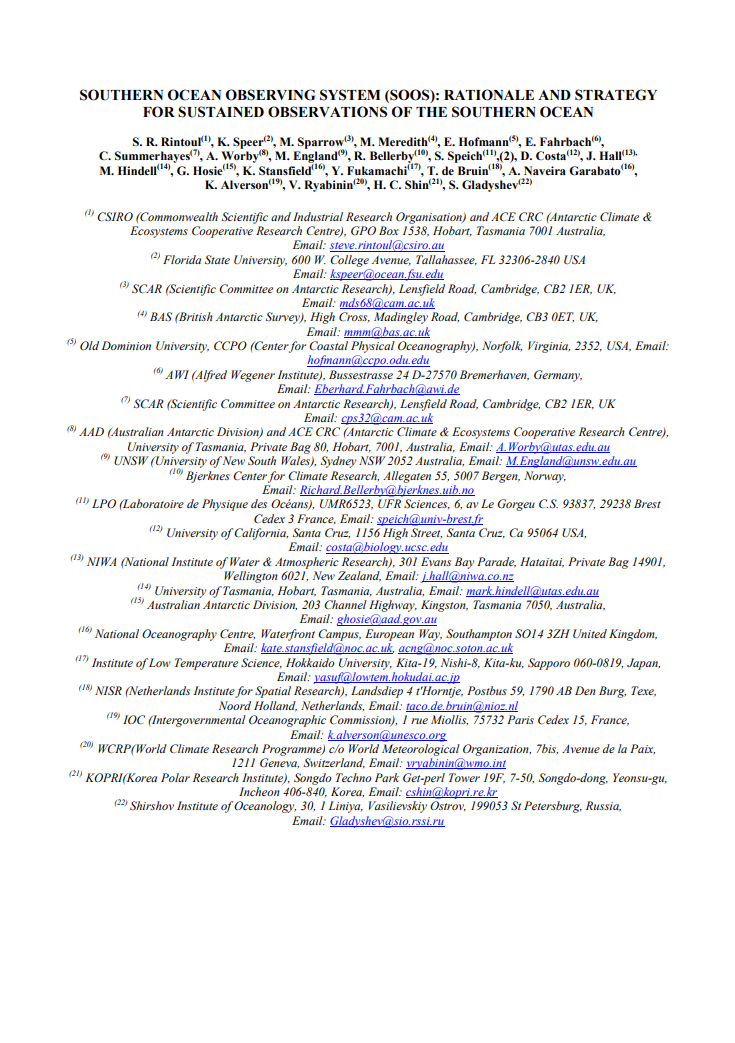
THE VISION BEGINS in 2010 | SOOS was formally articulated through the landmark paper "Southern Ocean Observing System (SOOS): Rationale and Strategy for Sustained Observations of the Southern Ocean" establishing the vision for an internationally coordinated and sustained Southern Ocean observing system.
- Publication of the foundational SOOS paper outlining the rationale and strategy for sustained Southern Ocean observations.
- Recognition of the need for an internationally coordinated observing and data delivery system for the Southern Ocean.
- Establishment of SOOS' mission to "facilitate and enhance Southern Ocean observations."
- Identification of key scientific and societal benefits of sustained Southern Ocean observations.
- Development of a strategic framework to guide future coordination, collaboration, and data sharing across the Southern Ocean community.
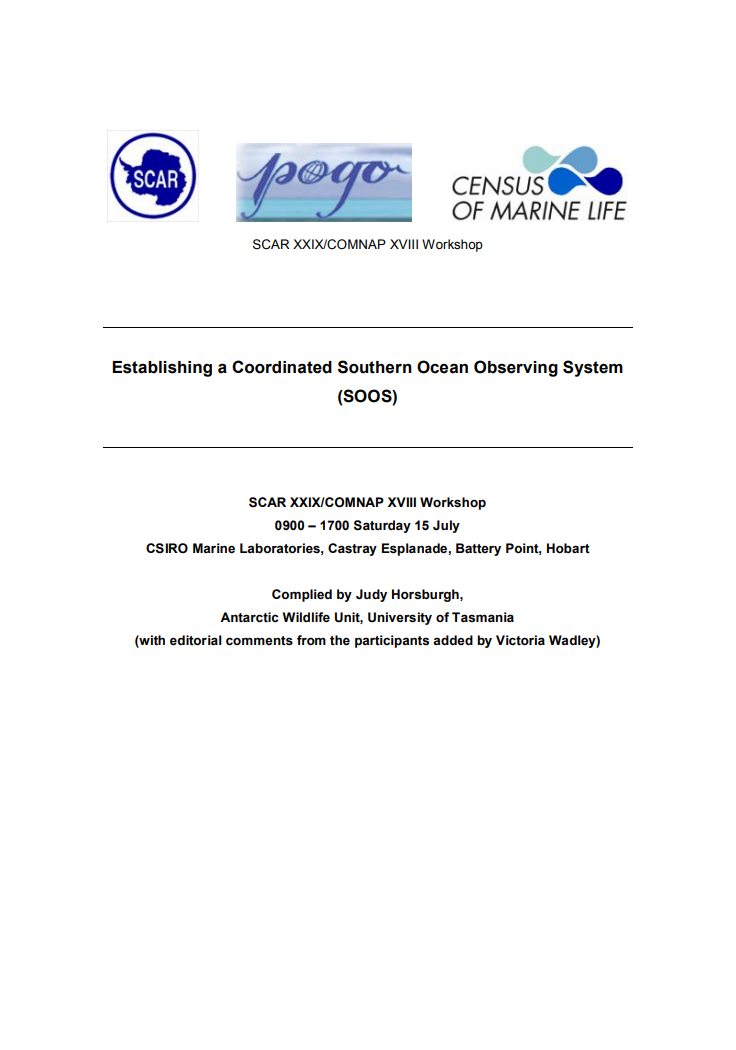
THE IDEA TAKES SHAPE in 2006 | The Southern Ocean community came together in a workshop to explore the feasibility of establishing a coordinated Southern Ocean Observing System, laying the groundwork for what would eventually become SOOS.
-
International workshop held alongside SCAR XXIX/COMNAP XVIII to assess the need for a coordinated Southern Ocean observing system.
-
Recognition of the importance of sustained and coordinated Southern Ocean observations and improved data delivery.
-
Development of an initial vision for integrating multidisciplinary observations across the Southern Ocean.
-
Identification of key priorities, including data management, technology development, biological observations, and long-term coordination.
-
Establishment of a framework and leadership group to take the concept of SOOS forward.
News article 23/Jul/2026/JB