
The final phase for the Ocean Regulation of Climate by Heat and Carbon Sequestration and Transports (ORCHESTRA) programme

ORCHESTRA is coming to an end! After almost five years of hard work by several dozens of UK researchers this intensive programme of observations, modelling and dynamical research into the Southern Ocean’s role in the ocean’s exchange of heat and carbon with the atmosphere is beginning to wrap up. ORCHESTRA was conceived as part of a new UK Natural Environment Research Council (NERC) strategy to encourage its component research centres to collaborate more closely, and to undertake more bold research than any one centre could do on its own. Led by the British Antarctic Survey (BAS), ORCHESTRA combines the resources and expertise of the National Oceanography Centre (NOC), British Geological Survey (BGS), Plymouth Marine Laboratory (PML), the Centre for Polar Observation and Modelling (CPOM), the Sea Mammal Research Unit (SMRU) and UK Met Office in an ambitious five year, £10M programme.

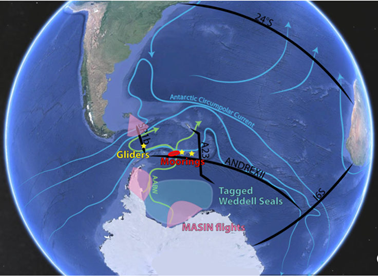
ORCHESTRA has involved a combination of data collection, analyses, and numerical simulations aimed at improving our ability to measure, understand and predict the circulation of the Southern Ocean, notably the South Atlantic/Weddell Sea, and its role in the global climate. It has made unique and important new measurements in the Southern Ocean using a range of techniques, including numerous voyages of the RRS James Clark Ross, deployments of autonomous surface and underwater vehicles and moorings, BAS meteorological aircraft flights, and other innovative techniques for collecting data. It has also developed and made use of advanced ocean and climate simulations, to improve our ability to predict climatic change in coming decades. The fieldwork, supported by forward and adjoint modelling, has been constructed (Figure 1) in order to create two regional ‘boxes’ in the South Atlantic/Scotia Sea and the Weddell Sea sampled to GO-SHIP levels. This recently completed fieldwork permits a milestone calculation of regional heat and carbon storage and transports, as well as the inference of interior mixing and surface fluxes via inverse methods.
ORCHESTRA has produced some excellent observational datasets, including both repeat sections and one off process studies, in one of the most data sparse regions of the global ocean. Much of this data is now available for public use via the British Oceanographic Data Centre (BODC), and through SOOSmap. ORCHESTRA scientists have also been hard at work publishing these results, and over 70 papers have been published so far, covering topics from CO2 air-sea flux uncertainties, to SubAntarctic mode water formation variability, bottom water export slowdowns and ocean warming impacts on benthic biology and penguin foraging success! Many more, including the results of the large scale ‘box’ inversions, are well on their way.
Finally, this isn’t the end for ORCHESTRA. The very literally and appropriately named ENCORE (ENCORE is the National Capability ORCHESTRA Extension!) project has just been approved, extending and building on ORCHESTRA research until April 2022. To keep in touch with ORCHESTRA/ENCORE research and discover more about the team and our goals, as well as the related biogeochemical/ecological programme RoSES, please visit our webpage https://www.bas.ac.uk/project/orchestra/By Andrew Meijers